
OBJECTS Record
Images
Metadata
Catalog Number |
1903.001.011 |
Object Name |
Xylophone |
Collection |
D'Arusmont Collection |
Source |
Kenneth Sylvan Guthrie |
Place of Origin |
France, Paris |
Place |
France, Paris |
Description |
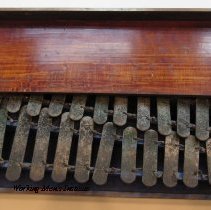
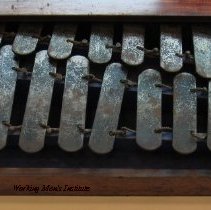
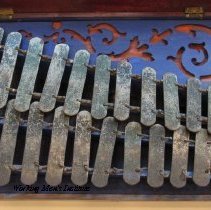
Box of tuned metal strips. No identifying marks, neither owner nor maker. Wooden box. Lid is hinged in half, and at the back, so that it folds open - but will not stay open unless supported. Two rows of metal strips, strung together with cords, which also give them a surface to rest on. Nails between the metal strips and cords are looped around them to keep the strips apart from each other. What appears to be a sound box at back. Letters incised on strips (from upper left to lower right, top row of 12 strips, bottom row of 13 strips): top row: "CIS/DOb" "DIS/REd" "F/FA" "G/SCI" "A/LA" "H/SI" "CIS/DOd" "DIS/REd" "F/FA" "G/SCI" "A/LA" "H/SI" bottom row: "C/DO" "D/RE" "E/MI" "FIS/FAd" "GIS/SCId" "B/SIb" "C/DO" "D/RE" "E/MI" "FIS/FAd" "GIS/SCId" "B/SIb" "C/DO" |
Provenance |
Card reads
|
Notes |
Early Paris [France] box of two octaves of metal strips, tuned. This resembles the symmetrical keyboard; it is two octaves of half steps. DO RE MI FA SOL LA TI DO becomes DO RE MI FA SCI LA SIb DO. Each note has a half step between it and the next, so there are notes between E and F and B and C. A tune could be easily played in whatever key the player chose. Labeling on strips - is it in French? does it reflect d'Arusmont's musical notation system? Puzzling that there are no identifying marks. Puzzling that the lid is not apparently made to stay open - how then would the thing be played, especially the back row of strips? Is there some mechanism for holding the lid open, that we haven't identified? |
Dimensions |
H-4.125 W-22.675 D-13.675 inches |
Material |
Wood/Iron/Cord |
Owned |
Phiquepal d'Arusmont |
People |
d'Arusmont, Phiquepal Guthrie, Kenneth Sylvan |